In many workplaces, used containers are not really empty: they contain traces of paints, solvents, oils, adhesives, biocides or industrial cleaning products, among other substances. If not properly separated and controlled, they can cause incidents, contamination and compliance problems.
Therefore, managing contaminated packaging is not just a formality: it is a safety and environmental responsibility measure.
What is considered “contaminated packaging”?
A package is considered contaminated when, after use, it has contained or contains traces of substances (liquid or solid) from the original product that may pose a risk to health and the environment. Typical examples:
- Drums with solvent or oil residues.
- Industrial detergent bottles with liquid product residues.
- Containers with solid or pasty paint residues.
- Partially empty aerosols.
- Containers with hazard labels or hazard pictograms.
The key is to evaluate the contents, review its Safety Data Sheet (SDS) and classify the waste with the LER code.
Risks of poor management
Poor management of contaminated packaging can have multiple consequences:
On the one hand, it increases safety and ORP risks, because chemical incompatibilities, exposure to vapors, spills or even fires or explosions can occur; on the other hand, it can lead to sanctions or non-conformities in audits if there is no adequate segregation, correct labeling or documentary traceability of the waste; and, in addition, it can generate a significant environmental impact if there are leaks into the soil or water, or if recyclable fractions are mixed with waste that requires a treatment that is different from the rest.
Practical steps to manage contaminated packaging
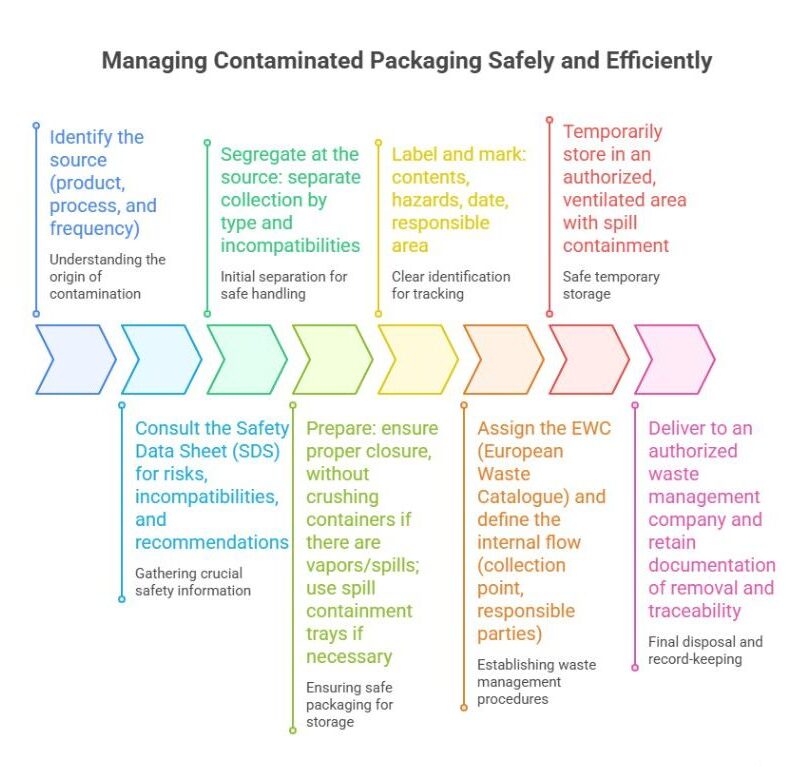
To make it easy and replicable on a daily basis, here is a checklist with the key steps to manage contaminated packaging safely, correctly and with traceability:
- Identifies the origin (product, process and frequency).
- See SDS for hazards, incompatibilities and recommendations.
- Segregation at source: Separate collection and storage by type of container.
- Condition: Correct sealing, no crushing of containers if there are vapors/spills; use of buckets if applicable.
- Assign the correct LER: Consult the SDS of the waste and contact your waste manager if you have any doubts.
- Label and indicates: Contents, hazards, storage date, responsible area.
- Temporary storage: In authorized area, under cover, ventilated and with spill control.
- Delivery to carrier and authorized manager and keep the withdrawal documentation to control the traceability of your waste.
Documentation and traceability
Digitally stores a waste file: product SDS, separate collection records, labeling, delivery notes/documents from the carrier and authorized manager and internal evidence (photos, checklists, trainings). This facilitates audits and avoids repeated errors.
Common mistakes and how to avoid them
A common mistake is to mix containers of different types thinking that, being “empty”, they do not pose any risk, when the correct thing to do is to segregate them according to the product previously contained and their incompatibilities, in addition to taking into account the type of container itself (plastic, metal, glass…).
It is also common to transfer them to their storage area without labeling, which complicates traceability, increases the likelihood of mixtures and leads to a reduction in their subsequent recycling and recovery. It is therefore advisable to label the waste correctly at source.
Another mistake is to store them without containment measures, so that any leak or spill goes unchecked, something that can be avoided with buckets and a basic spill prevention system.
Finally, many companies try to “recycle” these containers as if they were conventional, uncontaminated plastic or metal, but first it is always necessary to verify whether they can be managed in this way and which is the correct circuit according to their classification.
Managing contaminated containers correctly reduces risks in the workplace, avoids hazardous mixtures, improves spill control and reduces environmental hazards. It also reinforces regulatory compliance and waste traceability, facilitating audits and avoiding non-conformities. With proper segregation at source, good labeling and a clear circuit with an authorized transporter and manager, management becomes simple, safe and sustainable.
Frequently Asked Questions
Does a container with even the slightest film of product count as contaminated?
If hazardous residues (hazardous, vapors, incompatibilities) are present, treat as contaminated and manage according to SDS.
Can I rinse the container for recycling?
Only if the process is defined, secure and documented. If not, prioritize controlled management.
What about aerosols or pressurized cartridges?
They require special attention due to pressure and risk of ignition; segregate and manage with a specific flow.