Every time waste leaves one facility to be treated at another, a process begins that involves very specific legal obligations.
For companies that generate hazardous and non-hazardous waste, having a thorough understanding of these rules is not just a matter of compliance. A mistake in the documentation can halt a pickup, cause the waste to be rejected at the destination, or result in penalties. In this article, we review what the regulations say and how to safely organize waste transport.
What is considered a waste shipment?
Royal Decree 553/2020, dated June 2, is the regulation governing the shipment of waste within the territory of the State. It applies to shipments of waste between autonomous communities for recovery or disposal, including those destined for interim treatment or storage facilities. This royal decree forms part of the general framework of Law 7/2022 on waste and contaminated soil for a circular economy.
Not all transportation constitutes a transfer for legal purposes. The regulation excludes certain initial collection activities, such as transportation carried out by installation or maintenance companies from the location where the waste is generated to their own facilities, provided that such transportation results from their business activities. Subsequent transportation from the producer’s facility to the treatment facility would, however, constitute a transfer.
What about waste shipments within the same autonomous community? The second supplementary provision of the Royal Decree establishes that the autonomous communities regulate shipments within their territory and must do so in a manner consistent with the European shipment regime, particularly with regard to the identification document, the treatment contract, and prior notification. For this reason, it is also advisable to review the applicable regional regulations.
Who is the transfer operator?
The waste shipment operator is the party responsible for the main documentation obligations. In accordance with the hierarchical order established by law, the waste generator is, by default, considered the shipment operator. However, the regulation provides for other possibilities:
- The manager of a collection warehouse, when he or she consolidates small quantities of waste from various producers into a single vehicle.
- An agent or dealer, provided they have been authorized in writing by one of the aforementioned operators. If the dealer or agent fails to fulfill their responsibilities, the party that authorized them shall be held liable.
- The owner of the waste, when none of the above parties are known.
Correctly identifying the operator from the outset prevents duplication and gaps in the chain of responsibility.
Required shipping documents
The regulations are based on three transfer documents. The first two apply to all transfers; the third is required only in certain cases.
Data Processing Agreement
The Treatment Contract is an agreement between the shipper and the operator of the destination treatment facility, and must be in place before any shipment begins. It typically covers all shipments scheduled during a specified period.
The contract must specify, among other things, the estimated amount of waste, its EWC code, the frequency of shipments, the planned treatment, the conditions of acceptance, and the obligations of each party in the event that the recipient refuses to accept the waste.
Identification document
It tracks waste from its point of origin to its final destination. It provides real-time information on the type of waste, its origin and destination, the transfer operator, and the carrier’s details. The destination manager uses it to record whether the waste has been accepted or rejected.
In the event of rejection, the operator may return the waste to its place of origin (with an identification document indicating the return) or send it to another facility, with a new identification document; the operator remains the same for this new transfer.
Identification documents are key to traceability. The transfer operator and the parties involved, including the carrier, must include this information in their chronological records and retain a copy signed by the recipient for at least three years.
On this point:
- The destination operator has a maximum of 30 days from the date of delivery to submit the completed identification document, indicating the date of acceptance or rejection.
- For transfers with prior notification, the operator retains the notifications for at least 3 years after they expire.
Prior Notice
It is mandatory in two cases:
- Shipments of hazardous and non-hazardous waste intended for disposal.
- Transports of hazardous waste, mixed household waste (LER code 20 03 01), and other wastes as specified by regulation, intended for recovery.
Once the notification has been filed, the autonomous communities of origin and destination have 10 days to object to the transfer, or 2 days in the event of force majeure, an accident, or another emergency. If no objection is raised within that period, the transfer may proceed. In addition, it is possible to submit a general notification, valid for up to three years, for waste with similar physical and chemical characteristics that is destined for the same facility.
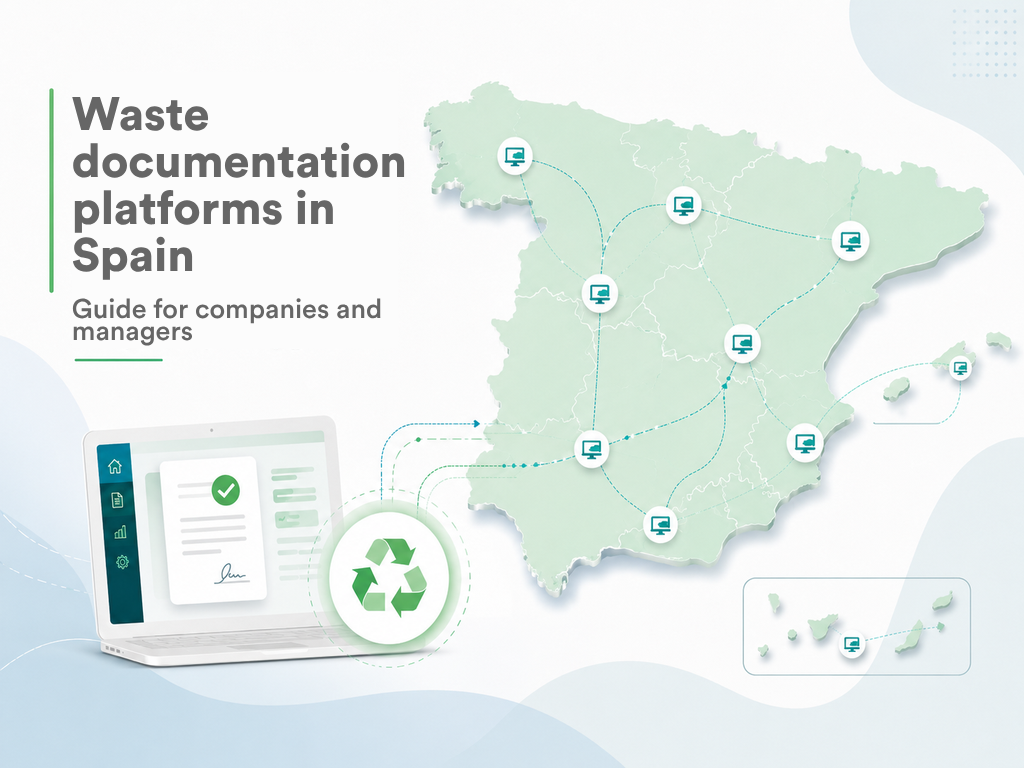
According to the first additional provision, these procedures are carried out electronically, either through the Ministry’s system (eSIR) or through each autonomous community’s electronic portal, depending on the option chosen by each region. If you’d like to learn more about this, we explain it in our article on waste documentation platforms in Spain.
Transfers outside Spain: a different framework
When waste enters or leaves the country, European regulations apply: Regulation (EU) 2024/1157 of April 11, 2024, which replaces the previous regulation from 2006.
With most of its provisions effective as of May 21, 2026, the regulation requires that international shipments subject to notification or general reporting requirements be processed electronically through the DIWASS platform. This is a different area from that of waste shipments within the country, but it is becoming increasingly relevant for industries with treatment facilities in other countries.
Common Mistakes and How to Avoid Them
In practice, many incidents in waste management stem from preventable errors:
- Initiate the transfer without a valid processing agreement.
- Failure to determine whether the waste requires prior notification.
- Using an electronic procedure that does not correspond to the autonomous community of origin or destination.
- Do not keep signed copies of identification documents.
- Failure to take into account that, if the waste is classified as hazardous material, its transport may also be governed by ADR regulations.
Working with a licensed and experienced waste management company helps prevent these mistakes. A good waste management company understands the requirements for each type of waste, coordinates with all other parties involved, and ensures documentation traceability for every movement.