If your company generates, transports, or manages hazardous or non-hazardous waste in Spain, paper-based procedures are a thing of the past. Since the enactment of Royal Decree 553/2020, the prior notification (NT) and identification document (DI) for each shipment must be processed electronically through documentation platforms.
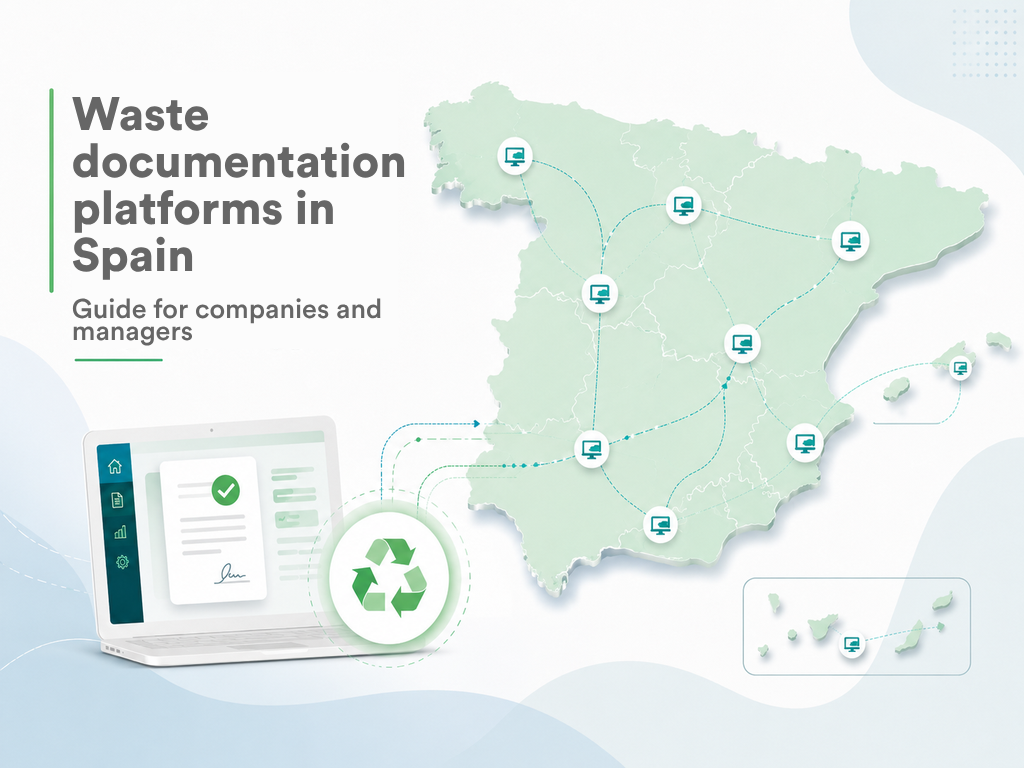
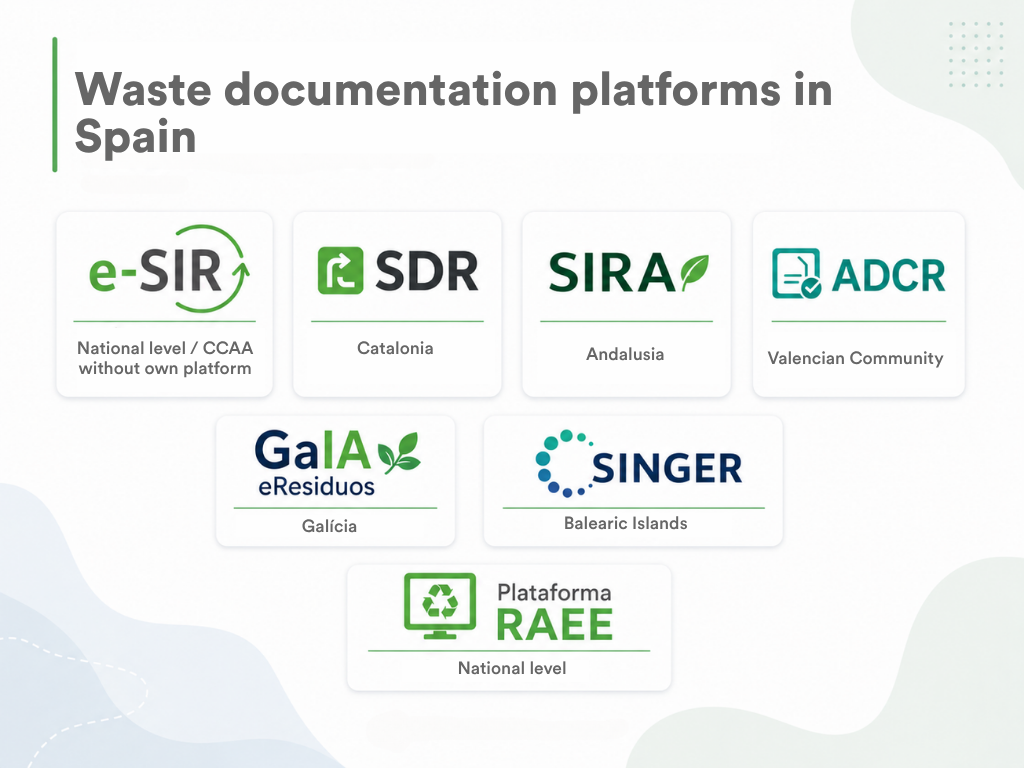
What complicates day-to-day operations is that there is no single national documentation platform: each autonomous community decided whether to adopt the Ministry’s platform or develop its own system. The result is a landscape of seven platforms—e-SIR, SDR, SIRA, ADCR, GaIA, SINGER, and the WEEE platform—which coexist depending on the origin and destination of each type of waste. Using the wrong channel can invalidate a notification and result in penalties, so it’s important to be clear about which platform applies to each shipment.
What all platforms have in common
Before delving into each system, it is important to understand the elements that are common to all of them, as they form the basis of Royal Decree 553/2020:
- Prior Notice (PN): Required for hazardous waste, for EWC code 20 03 01 (municipal waste), and for other types of waste as determined. It must be submitted at least ten days in advance.
- Identification Document (ID): Required for all shipments. Part A is completed by the operator and accompanies the waste during transport; Part B is completed by the waste manager upon receipt.
- Shipper: The party responsible for providing notification, typically the original generator of the waste (or whoever assumes that role: agent, dealer, or manager).
- Regional Elections: Each autonomous community has chosen either e-SIR or its own electronic portal.
National documentation platforms
Depending on the autonomous community, the most commonly used platforms are as follows:
e-SIR: the Ministry’s national platform
The Waste Information System (e-SIR), operated by the Ministry for Ecological Transition, serves as the standard for waste transfers between autonomous communities and for those that do not have their own system. It enables the electronic exchange of advance notifications and identification documents, and allows the receiving waste manager to accept or reject the waste. It is based on the E3L language and validates each document against the Waste Production and Management Registry (RPGR). Autonomous communities such as Aragon, Madrid, Castile and León, and the Canary Islands process their transactions through e-SIR.
Common mistakes: Failing to comply with the minimum ten-day advance notice requirement, submitting the portion of the document pertaining to transportation before the advance notice has been validated, or using expired digital certificates.
SDR: Catalonia’s waste documentation system
Catalonia maintains its own procedure, the SDR, managed by the Catalan Waste Agency (Agència de Residus de Catalunya). It allows for registration as a producer (with an associated code), the acceptance form, and the tracking sheet (FS), the Catalan equivalent of the DI. A digital certificate is required. For shipments from Catalonia to another autonomous community, e-SIR is used.
SIRA: The Andalusian platform
SIRA replaced the former Augias system in 2021 and centralizes all waste movements originating in or destined for Andalusia, whether internal or interregional. Access is granted via a digital certificate or Cl@ve. It requires a digital signature on the NT and Part B of the DI—without a signature, the deadline does not begin to run—validates against the RPGR, and automatically generates chronological reports and annual reports.
ADCR: The Valencian community’s app
ADCR 3.0 / E3S 3.0 manages transfers with origin and destination within the Valencian Community; inter-regional transfers are handled through e-SIR. It offers web services (E3S 3.0) to integrate document generation directly from companies’ own systems, at no cost to SMEs or large companies. Access requires an advanced electronic signature from the operator or an accredited representative before the ACCV.
GaIA: The Galician environmental information platform
In Galicia, transfers—whether within the region or to other autonomous communities—are processed through GaIA eResiduos, which replaced the former SIRGa. It allows users to record notifications and shipments (including the Outbound Control Document and cross-border shipments), confirm them with an electronic signature, and maintain records of incoming and outgoing shipments.
SINGER: The Balearic Islands’ notification and case management system
SINGER, part of the Balearic Islands’ Regional Ministry of the Environment and Territory, manages the Waste Production and Management Registry and the electronic registry for advance notifications and shipments originating in or destined for the region. It consists of SINGERFRONT (for companies) and SINGERBACK (for government), and supports registration via the web, E3L files, or web services. It allows the Waste Identification Document (DI) to be generated without a prior Transport Note (NT) in cases such as itinerant collection to the company’s own authorized facilities.
WEEE Platform: The system specifically for electrical and electronic equipment
Apart from general waste disposal platforms, waste electrical and electronic equipment (WEEE) has its own system, regulated by Order TED/1032/2024. It consists of two parts: the electronic management platform, which compiles data on inflows and outflows provided by local authorities, distributors, waste management companies, and extended producer responsibility (EPR) systems (with an internal portal for consultation and an external portal for registration); and the collection assignment office, which allocates collection responsibility among collective and individual systems based on their market share.
How to determine which platform is right for your business
In practice, the choice depends on the origin and destination of the shipment:
- Origin and destination within the same region with its own platform (Catalonia, Andalusia, the Valencian Community, Galicia, or the Balearic Islands) → that regional platform.
- Transfers between regions, or to a region without its own system → e-SIR.
- Waste electrical and electronic equipment under extended producer responsibility → submit the report on the WEEE platform.
Each system has its own access procedure, signature format, and validation checks against the RPGR, which makes document management a common source of friction for industries, workshops, and environmental managers.

An authorized agent facilitates this part of the process
No platform exempts the production company from its documentation obligations, but working with an authorized waste management company that is familiar with each system reduces the risk of errors related to deadlines or formatting. At Sircat, we manage hazardous and non-hazardous waste at transfer and treatment facilities in Catalonia and the Valencian Community, and we routinely work with SDR, ADCR, and e-SIR to help our clients ensure regulatory compliance.