Proper waste management has become a fundamental pillar for companies, administrations and citizens. International commitments to sustainability and circular economy, together with the need to ensure traceability and proper treatment of waste, have prompted the creation of legal tools to ensure this control. Among them, the waste treatment contract is positioned as a key piece, by establishing the basis of responsibility and collaboration between those who generate waste and those who manage it in an authorized manner.
What is a waste treatment contract?
According to Royal Decree 553/2020 which regulates the shipment of waste within the territory of the State, the waste treatment contract is the formal agreement between the shipment operator and the treatment manager. It establishes the conditions under which the manager undertakes to treat the waste once it has been accepted. This contract ensures the correct traceability of the waste from its origin to its final destination, in accordance with the requirements of Law 7/2022, on waste and contaminated soils for a circular economy.
In practical terms, this contract binds two parties:
- The operator of the shipment: normally the producer or holder of the waste.
- The treatment manager: the authorized company that will carry out the recovery or disposal.
Its main objective is to ensure that waste is managed in authorized facilities, complying with the principles of environmental safety and extended producer responsibility.
Legal framework: Law 7/2022 and RD 553/2020
The treatment contract is mainly regulated by Article 5 of RD 553/2020, which develops the legal regime applicable to waste shipments in the national territory. This regulation complements Law 7/2022, which introduces a more sustainable and circular economy vision in waste management.
Both standards state that:
- The contract must be signed prior to the start of the first waste shipment.
- Its existence guarantees traceability and shared responsibility between producer and manager.
- Local entities are exempt only if they transfer waste to their own facilities.
These provisions seek to prevent the illegal transport and treatment of waste, ensuring effective control by the environmental authorities and transparent compliance with corporate obligations.
Content of the Treatment Agreement
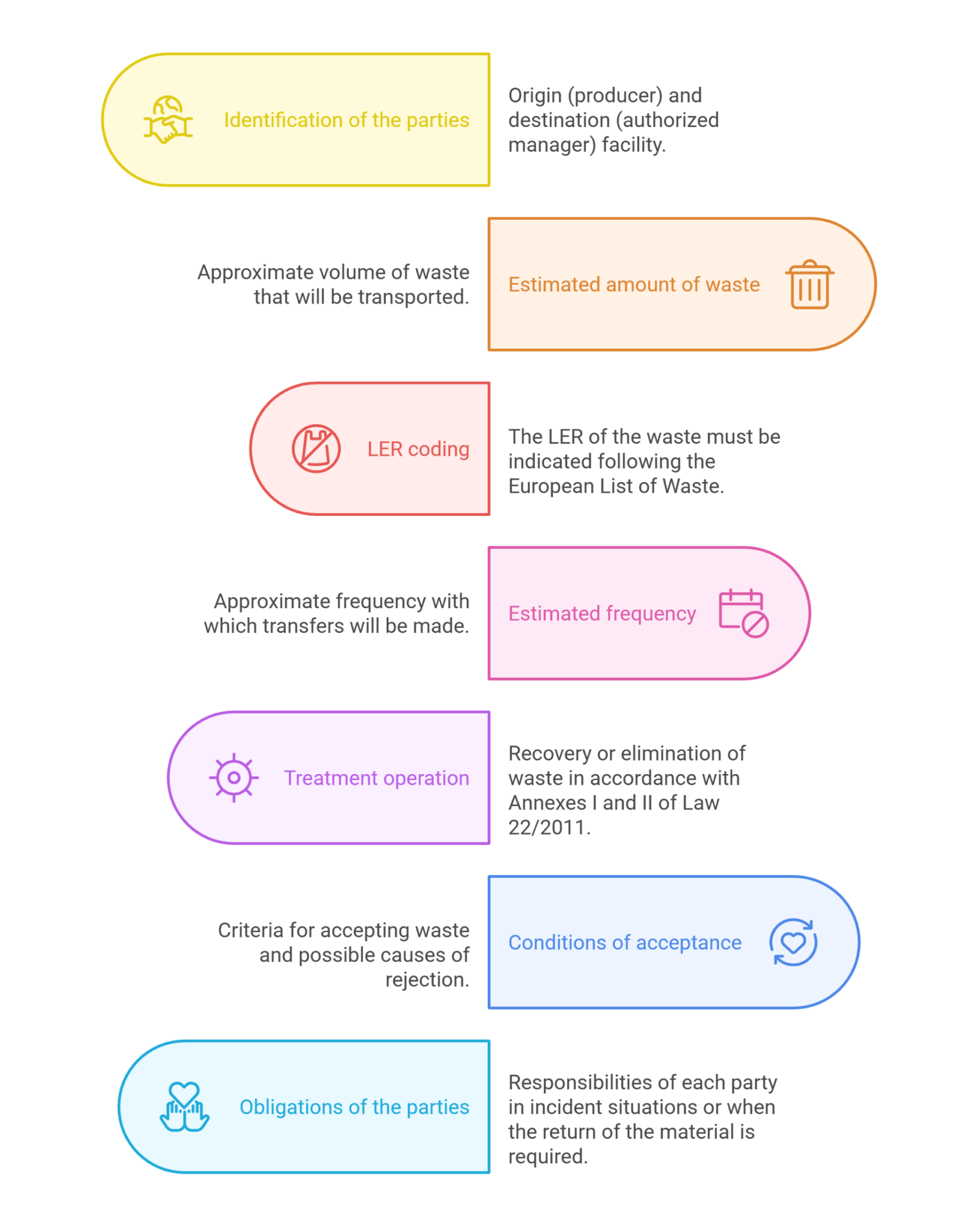
Article 5 of RD 553/2020 details the minimum elements that must be included in any waste treatment contract:
- Identification of the parties: Facility of origin (producer) and destination (authorized manager).
- Estimated amount of waste moved.
- LER (European Waste List) coding of the waste covered by the contract.
- Estimated periodicity of transfers.
- Treatment operation (recovery or disposal) in accordance with Annexes I and II of Law 22/2011.
- Conditions of acceptance and possible rejection of the waste.
- Obligations of the parties in case of incidents or return of material.
The contract must be signed by both parties and must be kept on file for at least three years as documentary evidence in case of environmental inspections or audits.
How to draw up a treatment contract step by step
The writing process may vary, but generally follows these steps:
- Waste identification: classify the waste and assign its LER code.
- Selection of the authorized manager: verify that it has a valid authorization and NIMA (Environmental Identification Number).
- Contract drafting: include all the points required by RD 553/2020.
- Signature and custody: both parties must sign and keep copies for the required period.
- Registration in eSIR: in some cases, it must be registered electronically through MITECO’s Waste Information System (eSIR).
Common mistakes and how to avoid them
Many companies make mistakes due to ignorance or lack of updating. The most common errors are:
- Omitting or incorrectly coding the LER: This can lead to confusion in the classification of the waste and make traceability difficult.
- Failure to include waste rejection conditions: This can lead to conflicts if the destination plant does not accept the material.
- Forgetting to sign the contract or letting it lapse: In validates the document in the event of an inspection.
- Use of old contractual models: This prevents compliance with the current legal requirements of RD 553/2020 and may result in penalties.
Importance and benefits of the treatment contract
Having a waste treatment contract is not only a legal obligation, but also a key tool for sustainable management and environmental transparency. Among its main advantages are the following:
| Benefit | Description |
| Regulatory compliance | Ensures that companies comply with current legislation and avoid penalties. |
| Traceability and control | Allows to know the path of the waste from its generation to its final destination. |
| Legal certainty | Defines clear responsibilities between producer and manager. |
| Environmental commitment | Demonstrates the company’s involvement with the principles of sustainability and circular economy. |
The waste treatment contract is much more than an administrative document. It is a key part of the environmental management system that protects the producer, guarantees traceability and promotes sustainable and responsible waste management. Complying with this obligation not only avoids penalties, but also reinforces the environmental reputation of companies in the eyes of customers, administrations and society.