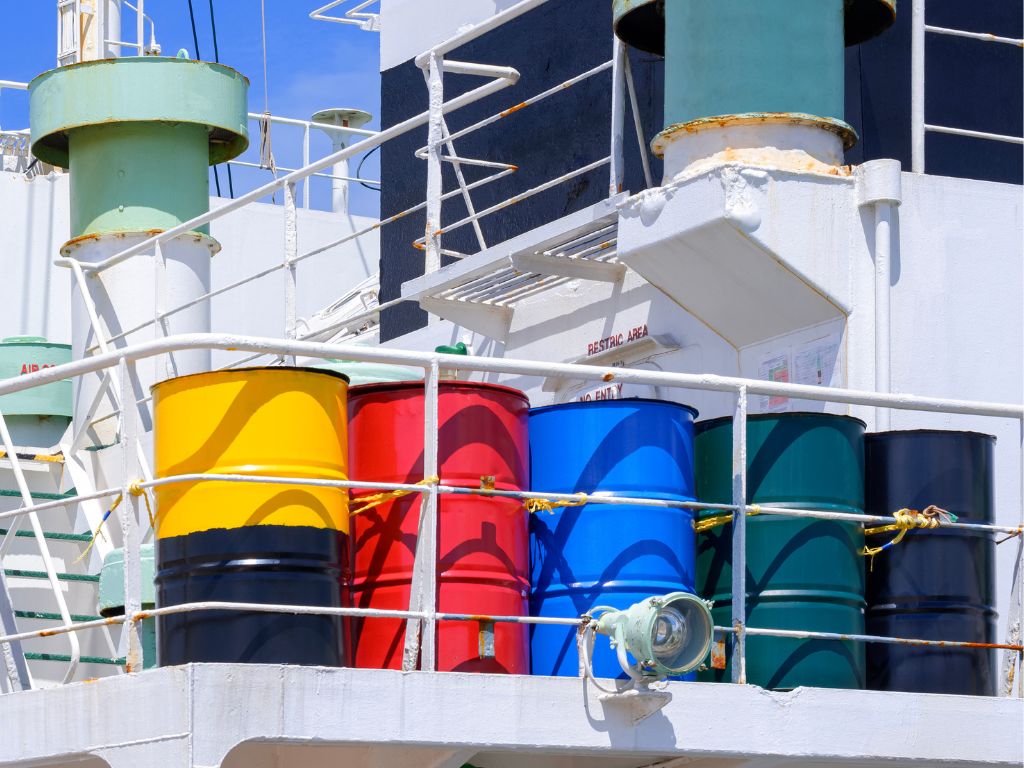
MARPOL wastes are wastes generated by ships during servicing, maintenance and cleaning. They are regulated by the MARPOL International Convention, the main international instrument to prevent pollution caused by ships, which obliges States to have port reception facilities for ships to deliver their wastes ashore so that they can be properly managed in the most sustainable way possible. In Spain, these facilities are regulated by Royal Decree 128/2022.
Types of MARPOL waste
The following classification identifies the types of waste commonly handled on board large ships:
- Hydrocarbons: Water contaminated with crude oil, petroleum products and oily mixtures from bilges or purification equipment.
- Noxious liquid substances transported in bulk and their residues.
- Dirty water from ships, ballast water and tank washings with hazardous mixtures.
- Vessel garbage: Household and operational waste, cargo residues, plastics, cooking oil, fishing gear, etc.
- Air pollution caused by ships: Waste from equipment containing ozone-depleting substances and from gas cleaning systems.
Legal framework in the European Union and Spain
The former Directive 2000/59/EC introduced in the European Union the obligation to provide ports with port reception facilities for the reception of ship-generated waste and cargo residues. In Spain this obligation was implemented with Royal Decree 1381/2002 on port reception facilities for ship-generated waste and cargo residues and is now updated by Royal Decree 128/2022 on port reception facilities for ship-generated waste, which transposes into Spanish law Directive (EU) 2019/883 on port facilities and repeals 2000/59/EC, thus reinforcing the availability and use of facilities to minimize discharges at sea and improve waste management on land.
Key obligations: ships and ports
The following are the basic responsibilities of ships and port facilities to comply with MARPOL at each port of call:
For vessels:
- Pre-notification of waste prior to the call (24h, upon knowledge of the port or upon departure from the last port as the case may be) through a one-stop shop; information must be kept on board and shared with authorities.
- Mandatory delivery of all waste to a port reception facility prior to leaving the port and obtaining a delivery receipt.
For ports/managers:
- To have adequate facilities, simple and fast procedures and rates that do not discourage delivery; to guarantee security in operations.
- Ensure sufficient capacity according to traffic, types and quantities of waste, and plan through reception and handling plans, reviewed at least every five years.
- Separate collection by fractions to facilitate reuse and recycling and management in accordance with LAW 7/2022, on waste and contaminated soils.
- Maintain computerized service records (searchable by authorities) for five years.
Best practices for efficient management
Applying good operational guidelines to comply with MARPOL reduces risks, costs and time at scale. The most common are:
- Plan delivery in advance through advance notification and verify on-board storage capacities.
- Segregate by annex (I, II, IV, V, VI) from the origin and label correctly.
- Coordinate with the receiving port facility and review the Port Reception Plan (procedures, rates, capacity).
- Document and retain delivery receipts and records for the required period.
The proper management of hazardous and non-hazardous waste generated under the MARPOL umbrella is a key part of protecting seas and coasts and ensuring safe and efficient port operations. Prevention begins on board – with good planning, segregation and traceability – and is consolidated on land through delivery to reception facilities and appropriate treatment, always prioritizing recovery whenever possible and in strict compliance with current regulations.
In this context, having a specialized partner makes all the difference. From a comprehensive and circular economy-oriented vision, Sircat accompanies organizations in the management of hazardous and non-hazardous waste from ships, thus helping to turn compliance into an opportunity for environmental and operational improvement.