Current environmental challenges such as climate change, water scarcity, dependence on raw materials and greater environmental awareness with responsible consumption among citizens and companies, are encouraging the latter to incorporate the circular economy strategy as an effective and sustainable business model.
What is the circular economy?
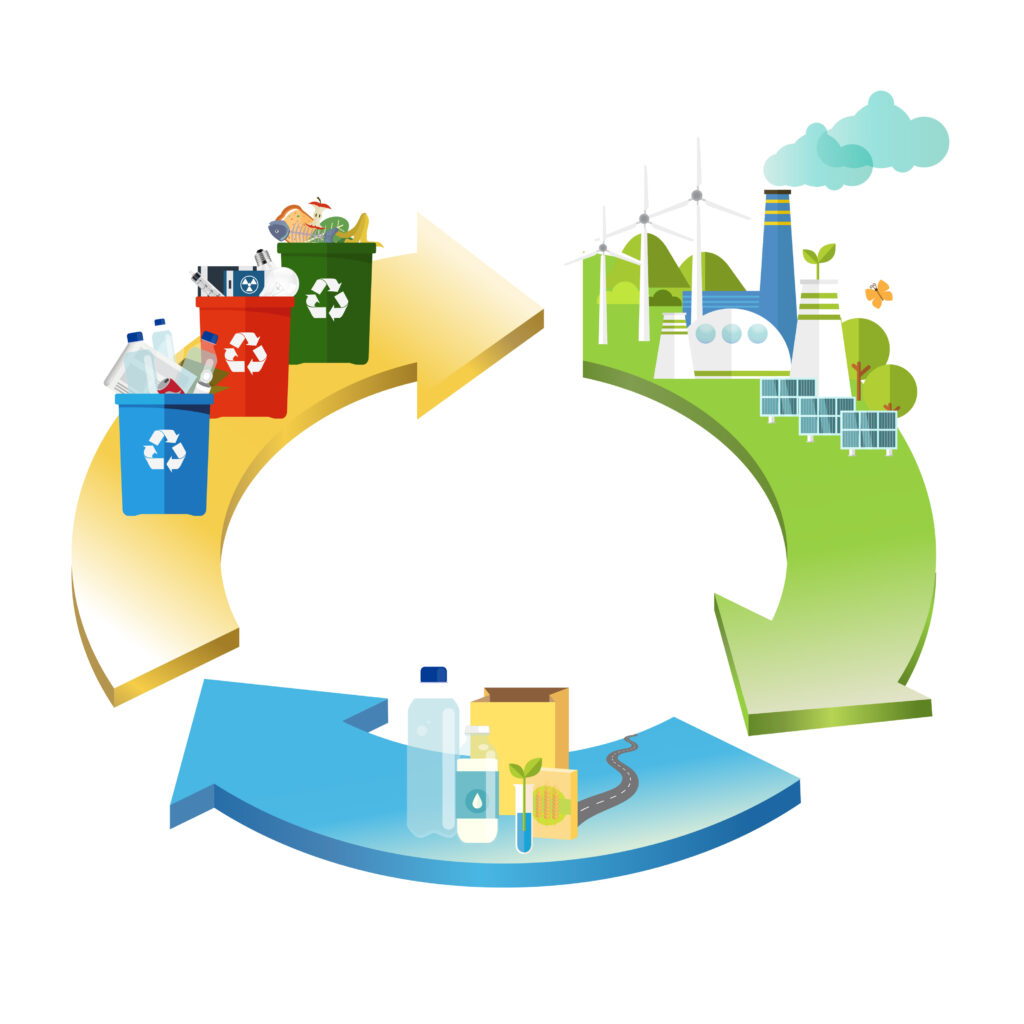
The circular economy is an economic model that guarantees the sustainable future growth of society by focusing on reducing, recycling and reusing everything that reaches the end of its useful life through efficient production and consumption systems. In this model, waste is converted into resources and products at the end of their useful life are reintegrated into the production cycle instead of being discarded.
It is estimated that this new circular business model represents the greatest economic revolution in the last 250 years, bringing economic, social and environmental benefits such as resource efficiency, waste reduction, reduced price volatility and uncertainty in the supply of raw materials, among many other benefits. In addition, it fosters innovation, the creation of new jobs and reduces toxic greenhouse gases, thus improving the health and quality of life of citizens.
This paradigm shift requires a comprehensive change in business, territorial and individual management on the part of everyone, in addition to being accompanied by a legal framework that encourages this transformation. This transformation affects the entire value chain and requires the participation of all types of agents involved. Collaboration and joint cooperation is essential to establish stable relationships based on stability and trust in order to achieve sustainable development.
Main objective of the circular economy
The main objective of the circular economy is to preserve natural resources within a continuous life cycle, optimizing their value. Through specific strategies, it seeks to retain the maximum value of resources for as long as possible, leaving aside the old model of production and consumption based on extract, manufacture, use and throw away.
Benefits of the circular economy
The circular economy offers a number of key environmental, economic and social benefits:
Environmental protection
The circular economy promotes the reuse, recycling and recovery of materials, which reduces the need to extract natural resources from the Earth such as minerals, wood or fossil fuels, thus reducing the environmental impact associated with mining, deforestation and drilling, among others. In addition, the circular economy reduces the amount of waste that ends up in landfills or incinerators. This helps prevent soil, water and air pollution, reducing the negative effects of waste accumulation in the environment and preserving biodiversity and ecosystems. As if that were not enough, CO₂ emissions would decrease, since the production of the materials we use on a daily basis are responsible for 45% of the emissions of this gas.
Economic benefits
Through the circular economy, we avoid the extraction of raw materials, reducing countries’ vulnerability to price fluctuations and increasing security of supply, which improves economic stability, in addition to cost savings. This also reduces dependence on raw material sources located in specific geographic regions, which reduces geopolitical risks and promotes a more equitable distribution of resources globally. In turn, by encouraging the creation of new industries and sectors related to the circular economy, it diversifies the economic base and boosts employment generation.
Social benefits:
The circular economy improves public health by reducing pollution and creates employment in sustainable sectors with an expected 700,000 jobs in the EU alone by 2030 by promoting social inclusion and environmental awareness. It fosters community participation and strengthens social cohesion, thus improving quality of life and promoting more equitable and sustainable development for all.
Examples of circular economy
More and more companies are adopting circular economy practices in their operations and business strategies as awareness of environmental challenges and the need for more sustainable development grows:
Cator
Cator is dedicated to the regeneration of used industrial oil, one of the most generated toxic liquid wastes in the world. Cator collects used oil from workshops and industries and regenerates it in such a way that it returns to produce a base oil suitable for the manufacture of all types of high quality remarketable lubricants. In this way, the regeneration of the oil becomes indefinite without any loss of quality, thus promoting the circular economy.
Grid Granollers
GRID Granollers is an initiative jointly promoted by the City Council of Granollers and the associations of the industrial parks of Granollers in order to promote industrial symbiosis and create competitive industrial parks. Through GRID Granollers, companies can share resources that they no longer need or that they make little use of, so that others can take advantage of them.
Backmarket
Backmarket is a global marketplace dedicated to the repair/upgrade and trade of used electronics, greatly reducing the environmental impact of refurbished products compared to new ones.
Collaboration with Repsol, Naturgy, Reganosa and Impulsa Galicia
They are currently developing a circular economy project that largely transforms surplus livestock manure and other waste into biomethane, organic fertilizers and neutral CO₂ of biological origin. This initiative has been conceived to optimize slurry management in the Galician autonomous community, reducing energy dependence from abroad.
In conclusion, the circular economy represents a new comprehensive and sustainable approach to address today’s environmental, economic and social challenges. By reducing dependence on raw materials, protecting the environment, generating employment and promoting social inclusion, this model offers a pathway to a healthier society. With the participation of governments, businesses and citizens, the circular economy can lead us to a more sustainable future.
At Sircat we offer environmental services to all types of companies providing quality solutions that promote circular economy and sustainable development.